

Aniket Roychoudhury Creates H2NoLead to Address Childhood Lead Exposure and Lead Poisoning Prevention Gaps in New Jersey

Aniket Roychoudhury
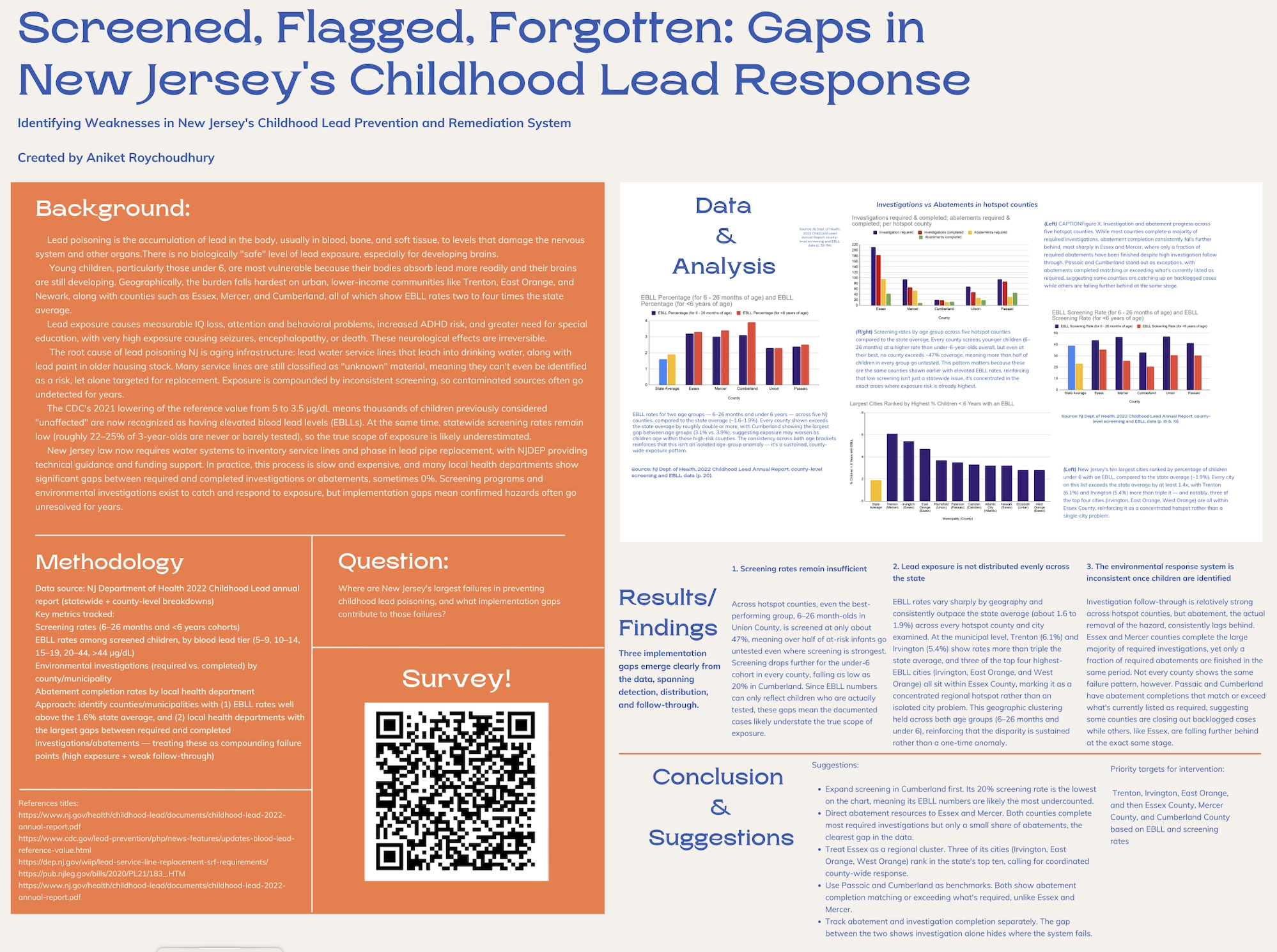
H2NoLead Research Poster
LIVINGSTON, NJ, UNITED STATES, August 17, 2026 /EINPresswire.com/ -- Most families don’t think twice before filling up a glass of water from the kitchen sink. Clean tap water is a basic need that millions of Americans move through daily life expecting to be there, with public drinking water systems regulated by the EPA and delegated to states and tribes serving 90% of the country. For Aniket Roychoudhury and his family, that sense of certainty disappeared in 2021, when Livingston, New Jersey’s tap water was shut down due to dangerous PFAS levels. This left Roychoudhury and his family buying gallon jugs of distilled water for over a year before eventually purchasing and installing their own home water purifier in 2023.
Living in a town where families expect basic public systems to keep drinking water safe, the experience became a pivotal moment for Roychoudhury. It forced him to think about what happens when communities lose trust in something as essential as the water coming from their taps, and what it means when the only immediate solution is one a household has to pay for on its own. While his family had the resources to buy distilled water and later install a purifier, he knew not every household could respond that quickly or absorb that cost. For Roychoudhury, his lived experience and research while living through it revealed that water safety is not only an environmental issue, but also an issue of public health equity.
As Roychoudhury began researching drinking water safety more intensely, he became increasingly focused on childhood lead exposure in New Jersey. He learned that lead poisoning is a man-made public health issue that requires urgent intervention, as children are 4 to 5 times more susceptible to ingested lead than adults from the same exposure level, according to the World Health Organization. Roychoudhury also learned that the burden of lead exposure is often concentrated in low-income urban communities, many of which are disproportionately home to families of color. While his own town had been affected and his family had the resources to respond, many families in Essex County and across New Jersey don't have the same option. Those risks made the issue impossible for Roychoudhury to ignore and led him to develop H2NoLead, a public health policy project focused on childhood lead exposure, community education, and the gaps that can interfere with prevention efforts reaching the families most at risk.
Roychoudhury’s H2NoLead centers on the idea that policymakers don't just need solutions. They also need to understand where implementation is failing, how families experience those failures, whether communities are aware of the issue, and what barriers prevent homeowners from protecting themselves.
As Roychoudhury continued researching the effects of lead exposure for H2NoLead, the issue became even more urgent. He found that lead poisoning can cause measurable IQ loss, attention and behavioral problems, an increased risk of ADHD, and a greater need for special education support. At high exposure levels, lead poisoning can also cause seizures, encephalopathy, or even death. But what concerned Roychoudhury most was learning that New Jersey already has laws requiring lead pipe removal and childhood lead exposure screenings, but neither are happening consistently. This gap became the foundation of H2NoLead: if New Jersey already has laws requiring lead pipe removal and childhood lead exposure screenings, why are families still falling through the cracks?
H2NoLead provides accessible information through an educational research poster designed to help New Jersey communities better understand childhood lead exposure, testing, prevention, and policy gaps. The poster breaks down the issue in an accessible way while connecting residents to a QR code where they can share their own perspectives on questions such as if they've experienced lead exposure concerns, where they're located, and what they believe should change in current policy. Roychoudhury is currently distributing the poster to libraries across New Jersey, beginning with the Livingston Public Library, so the information can reach families in public community spaces.
Through the responses collected from the QR code, Roychoudhury hopes to better understand where lead prevention efforts may be falling short in various communities. His goal is to organize the public feedback into a white paper that can be shared with policymakers, legislators, public health officials, advocates, and grassroots organizations working to improve lead poisoning prevention in New Jersey.
One of the biggest challenges Roychoudhury faced was learning how to translate his research into something communities could actually use. While he could easily spend weeks analyzing public health reports and identifying policy gaps, turning that research into a public-facing initiative required a different set of skills. Through H2NoLead, Roychoudhury realized that creating change would have to happen step by step, starting with gathering public feedback and building credibility around his findings before eventually bringing them to the stakeholders and changemakers positioned to support larger public health solutions.
Having his own tap water shut down wasn't the only thing that made this issue personal for Roychoudhury, learning that the EPA and Natural Resources Defense Council rank New Jersey sixth nationwide in projected lead service lines, with an estimated 527,686 lead pipes, made him realize that H2NoLead couldn't stop at his hometown. H2NoLead became Roychoudhury’s way of moving information out of reports and into the hands of communities that could use it. “It feels gratifying to be able to educate communities, even if it is just a handful of families being reached,” Roychoudhury shared. “Knowing that my work can raise awareness about an issue that often goes unnoticed has reinforced why I became interested in public health in the first place. I don’t want my work to amount to a research paper locked away in a musty filing cabinet. I want it to have an impact on society.”
That realization has also shaped how Roychoudhury thinks about public health more broadly. As he explained, “Good science alone doesn't solve problems if the people who need those solutions never benefit from them.” As H2NoLead continues, Roychoudhury plans to expand QR outreach to counties, municipalities, libraries, schools, and community organizations across New Jersey and the United States. He hopes the project will improve community awareness and help inform future policy conversations around childhood lead poisoning prevention.
To support Aniket Roychoudhury and learn more about H2NoLead, please share the project with New Jersey libraries, schools, pediatric offices, public health advocates, and families interested in childhood lead exposure prevention. For questions about the project and his research, please contact aroychoudhurycollege2027@gmail.com.
About Aniket Roychoudhury
Aniket Roychoudhury is a student at Livingston High School in Livingston, New Jersey. He is an AP Scholar with Distinction, a member of the National Social Studies Honor Society, Recruitment Chair of his school’s Ethics Bowl Team, and has been a member of the varsity saber fencing team since 2024. Through his work at the Geisinger Physician Ready Program, a pre-medicine program at the Geisinger Commonwealth School of Medicine, Roychoudhury researched GLP-1 medications and barriers patients face in accessing obesity treatment, which helped shape his interest in the intersection of medicine, public health, and health policy.
Contact
Aniket Roychoudhury
aroychoudhurycollege2027@gmail.com
Paige Torres
SBU PR
publicrelations@studentbrandingu.com
Legal Disclaimer:
EIN Presswire provides this news content "as is" without warranty of any kind. We do not accept any responsibility or liability for the accuracy, content, images, videos, licenses, completeness, legality, or reliability of the information contained in this article. If you have any complaints or copyright issues related to this article, kindly contact the author above.
